Protecting forests outside parks benefits the birds within
Every year, around 3.5 billion birds migrate to North America to breed, finding safe havens and nesting grounds in our national parks along the way.
But the best way to ensure these protected areas continue to help birds, researchers have found, may be to focus on what lies just beyond their borders.
That’s the takeaway of a study published Oct. 31 in the journal Landscape Ecology.
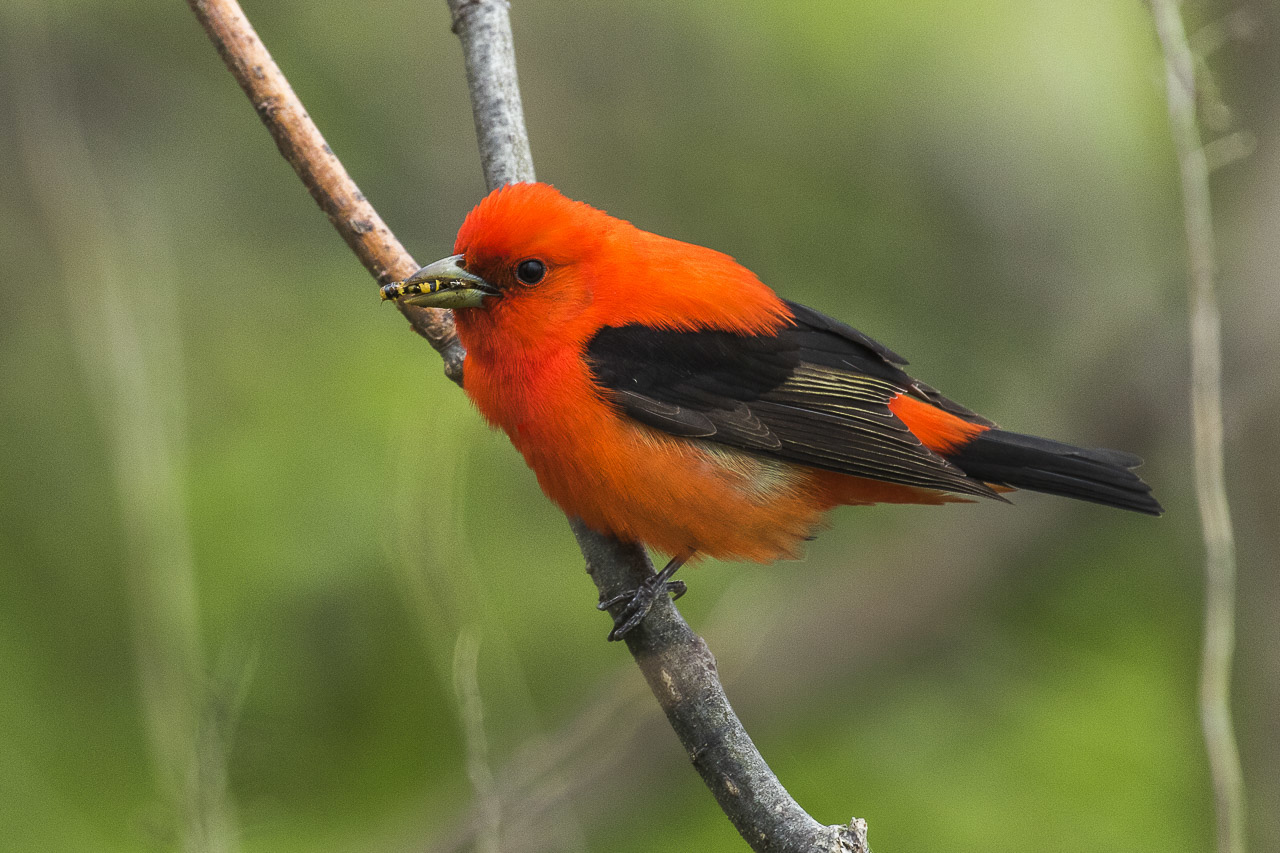
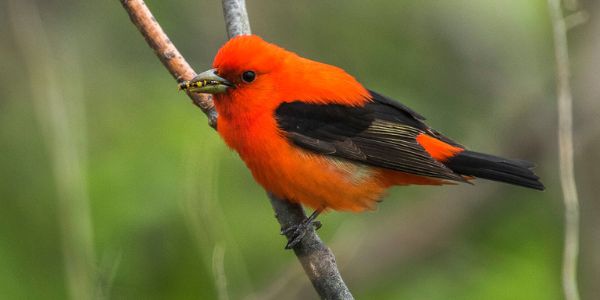
The scarlet tanager gets its name from the brilliant red plumage of the male birds. These birds migrate thousands of miles from South America to the eastern United States and southern Canada every year to breed. Credit: Francesco Veronesi, Wikimedia Commons
For the study, a team led by quantitative ecologist Elise Zipkin and doctoral student Bruna Amaral at Michigan State University analyzed 17 years of bird monitoring data collected between 2006 and 2023 in eight national parks in the northeastern United States.
Each year during the summer breeding season, National Park Service volunteers return to the same locations and record every bird they hear, from the high-pitched “pik!” of the downy woodpecker and the flute-like song of the wood thrush, to the “teacher teacher teacher” of the ovenbird.
Amaral, Zipkin and team also examined measures of forest structure at different spatial scales inside and outside each park, from within 400 meters of each bird sighting to the entire surrounding county.
The analysis clearly showed that the forest habitat in a bird’s immediate vicinity matters.
“Which is not surprising,” Amaral said. “That's where these birds are directly interacting with the forest to build nests, feed their young, and hide from predators.”
“We still saw a lot of variation in their specific needs,” she added. Stands with more shrub cover were more popular with black-throated blue warblers, for example; whereas stands with larger, thick-trunked trees supported more red-eyed vireos.

But while the local forest habitat was important, it was only part of the story. When they zoomed in and out between scales, the researchers found that the larger landscape beyond park borders mattered even more than the forest within.
Brown creepers, for example, were more likely to choose parks surrounded on the outside by acres of big, mature trees and more open understory, and were not significantly affected by forest structure inside park boundaries.
“For most of the 16 bird species we looked at, forest condition outside of parks was the most important factor in determining whether a species was likely to be present,” Amaral said.
“In other words, you can have a perfectly healthy park, but if it's sitting in a degraded landscape, the birds simply might not be there.”
One possible reason why the surrounding landscape is important could be because fledglings must leave the nest and gradually become more independent before they are ready to migrate back south. “They have to disperse a little bit, so it's important that wherever they head offers them a chance of survival,” Amaral said.
Pinpointing the spatial scales at which forests affect birds is important because birds across North America are in trouble, said Zipkin, who directs MSU’s Ecology, Evolution, and Behavior program.
By one estimate, wild populations of eastern forest birds are down 17% from half a century ago. Indeed, another study led by Zipkin and colleagues found that many of these populations continue to decline even in protected areas.
This doesn’t mean that national parks — places "set aside,” in large part, for nature — don’t benefit birds, Zipkin said.
Protected areas like national parks can offer birds and other wildlife a respite from stressors like hunting, development, and other human activities.
Indeed, previous studies suggest that, worldwide, protected areas contain more bird species than unprotected sites, and they are five times more effective at stemming species’ declines.
But while protected areas are important, they can’t save birds on their own.
“Our research shows that unfortunately, managing these parks in isolation isn’t enough,” Amaral said. “We need to start to think beyond park boundaries.”
The good news is that people can help. The results suggest that landowners can enhance the effectiveness of protected areas, even relatively small ones.
“What this study shows is that anything people do to make their backyards, farms and other privately-owned land more bird-friendly can spill over into protected areas, making them better for birds too,” Zipkin said.

This research was supported by grants from the National Science Foundation (DEB-2213565, DEB-2213565, DEB-2213565, DEB-2213565), and by the National Park Service’s Inventory and Monitoring Division (P22AC01616).
CITATION: "Protecting birds in protected areas: a multi-scale analysis of forest structure and species occurrence," Bruna R. Amaral, Jeffrey W. Doser, Aaron Weed, Kate Miller, Elise F. Zipkin. Landscape Ecology, Oct. 31, 2026. DOI: 10.1007/s10980-026-02477-x