Seed grants nurture new directions & collaborations campus wide
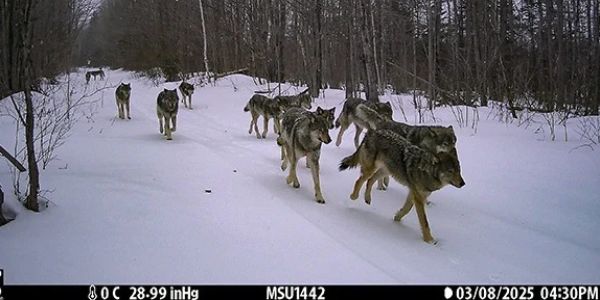
Between Ebola, Covid-19, and other outbreaks, concern over disease spillover from wildlife to humans is on the rise. How does the risk of zoonotic diseases change when people move from rural areas to urban centers?
In our oceans, temperatures are rising too. What does that mean for the tiny organisms at the base of the ocean food chain?
And closer to home, how do pesticides impact bees and other pollinators on Michigan’s canola farms?
EEB seed grants nurture new directions & collaborations campus wide
These and other questions are what drive the 12 research teams selected for the latest round of seed grant funding through MSU’s Ecology, Evolution, and Behavior program.
Launched in 2021, the EEB seed grant program offers researchers a jumpstart in an increasingly competitive and unpredictable funding landscape.
“Seed funding helps researchers gather preliminary data, demonstrate feasibility, and other key elements to developing a successful grant application,” said EEB director Elise Zipkin, who created the program. “Our goal is to help faculty prepare stronger external proposals and get one step closer to getting funded.”
This year’s recipients span six departments across MSU’s colleges of engineering, natural science, and agriculture and natural resources.
This is the sixth year that EEB has awarded seed grants to support faculty across the 13 departments represented under the EEB umbrella, with priority given to projects that bring together new collaborations or that represent new and promising research directions for MSU.
The seed grant program is made possible by generous support from MSU’s Office of Research and Innovation. To date, EEB has awarded more than $570,000 in seed grants to 43 faculty from five different colleges across the MSU community, yielding an additional $7,687,991 in external funding.
"At Michigan State we believe great discoveries often start small — with one bold idea and the support to test it,” said MSU’s Vice President for Research and Innovation, Shashank Priya. “EEB's seed grant program gives our researchers that chance, helping them explore new questions and build partnerships that turn early ideas into real scientific progress.”
“The results speak for themselves,” he added. “Every dollar MSU invests in this program has returned $13 in additional research funding, fueling work that benefits our state, our students, and our world. That's the kind of impact that comes from supporting our researchers early and often."
This year's selected projects include:
“Wind-driven dispersal dynamics of grass seeds with fine-scale morphologies"
- Lauren Sullivan, assistant professor of plant biology, Kellogg Biological Station
“The little catfish that could: Exploring a new origin of electrogenesis”
- Jason Gallant, associate professor of integrative biology
“The evolution of epigenetic regulation of dosage compensation across different sex-determining mechanisms”
- Anne Bronikowski, professor of integrative biology, Kellogg Biological Station; Ingo Braasch, associate professor of integrative biology; Fredric J. Janzen, professor of fisheries & wildlife, Kellogg Biological Station
“Leveraging ecological traits and ML/AI to predict the dynamics of plankton communities under changing conditions”
- Elena Litchman, professor of integrative biology, Kellogg Biological Station; Pang-Ning Tan, professor of computer science and engineering
“Assessing genomic connectivity and vulnerability of the threatened Florida scrub lizard”
- Sarah Fitzpatrick, associate professor of integrative biology, Kellogg Biological Station; Alexa Guerrera, NSF Postdoctoral Fellow, Kellogg Biological Station; Tyler Linderoth, research specialist, MSU Bioinformatics Core Facility
“Establishing a chromosome-level genomics pipeline in underrepresented tropical systems”
- Chan Kin Ohn, assistant professor of integrative biology
“Developing tools to understand information flow and functional structure of plant-virus coevolution”
- Emily Dolson, assistant professor of computer science and engineering; Carolyn Malmstrom, professor of plant biology
“Integrating NEON data to create metanetworks and model food-web dynamics at a continental scale”
- Phoebe Zarnetske, professor of integrative biology; Emily Dolson, assistant professor of computer science and engineering; Alisha A. Shah, assistant professor of integrative biology, Kellogg Biological Station; Christopher Klausmeier, professor, professor of plant biology and integrative biology
“Genome organization and the evolution of mutation rates across vertebrates”
- Ingo Braasch, associate professor of integrative biology; Blair Perry, assistant professor integrative biology
“A new theory of host-parasite-resource competition for predicting infection dynamics across biological scales”
- Nina Wale, assistant professor of integrative biology and microbiology, genetics, & immunology
“Effects of adjacent habitat on pollination services in Midwestern canola crops”
- Hannah Burrack, professor and chairperson of entomology; Lauren Sullivan, assistant professor of plant biology
“Urban impacts on epidemiological connectivity and viral spillover at the bat-livestock interface in Nairobi, Kenya”
- Christopher Kozakiewicz, assistant professor of integrative biology, Kellogg Biological Station
The EEB seed grant committee was co-chaired by Sarah Evans and Greg Bonito. Other members include Akihiro Koyama, Tammy Long, and Santiago Rodriguez Castro.
The next round of EEB Seed Grant Proposals for EEB core faculty members will be due in March 2027.