Meet the winners of the 2026 outstanding publication awards
Striking evidence of butterfly declines. What warming means for turtles. A second chance for woodpeckers. Insights from a century’s worth of herbarium specimens. There were some of the themes and findings from the winners of the 2026 Director’s Award for Outstanding Publication in Ecology, Evolution, and Behavior.
A total of 20 papers were nominated for this year’s award, which recognizes studies by current EEB graduate students that demonstrate novelty, creativity, and potential to influence future research and practice.
Awards were announced at the EEB Wine and Cheese Party on Friday, Feb. 6. Here’s what the selection committee (consisting of Chia Hsieh, Becca Nelson and Nicole Lussier) had to say about the researchers and their work:
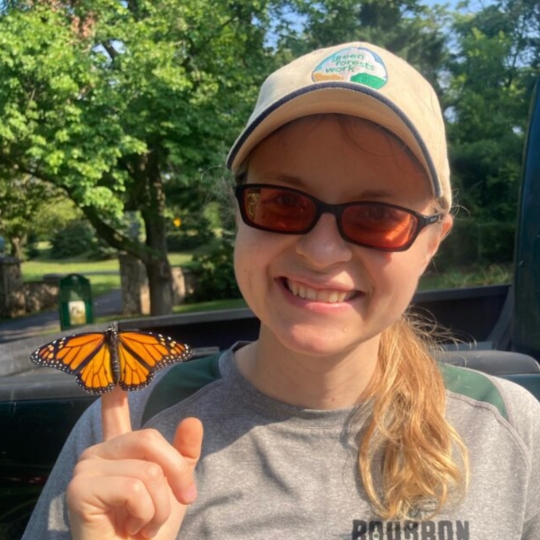
Winner 1: Wendy Leuenberger, Department of Integrative Biology
Publication: Three decades of declines restructure butterfly communities in the Midwestern United States.
Advisor(s): Elise Zipkin
This paper was awarded because it delivers an extremely comprehensive assessment of butterfly declines to date, leveraging a large-scale 32-year dataset that captures both common and rare species. We found the results extremely striking, that no species increased in abundance and that declines occurred uniformly across all functional groups. This paper really shapes our understanding of how biodiversity loss is structured within insect communities, and offers a really compelling, evidence-based call to reorient conservation toward whole communities rather than individual taxa.

Winner 2: Caleb Krueger, Department of Fisheries and Wildlife
Publication: The tortoise and the air: climate shapes sex-ratio reaction norm variation in turtles.
Advisor(s): Fredric Janzen
This paper offered a multi-scale examination of how temperature-dependent sex determination evolves across phylogenetic history and contemporary climatic gradients. This study provided a really novel framework that shows how fundamental traits underlying sex determination are not static, but evolve in predictable ways in response to environmental conditions. Its clear separation of long-term evolutionary patterns from short-term responses provided a powerful conceptual framework applicable well beyond turtles that are highly relevant in the context of global climate change.

Honorable Mention 1: Asia Hightower, Department of Plant Biology
Publication: Herbarium specimens reveal links between leaf shape of Capsella bursa‐pastoris and climate.
Advisor(s): Emily Josephs
This paper used large-scale and long-term herbarium specimens to investigate leaf shape variations in a species with highly variable morphology. Asia and other authors digitized roughly 500 herbarium specimens collected across the continental United States over a 100-year period and applied geometric morphometric techniques to quantify comparative variations in leaf shape. They further identified that temperature consistently structures leaf morphology across broad spatial and temporal scales, advancing our understanding of plant form-environmental relationships. Collectively, we found this paper presents a very strong analytical and conceptual framework for linking phenotypic variation to climate changes.

Honorable Mention 2: Alexander Lewanski, Department of Integrative Biology
Publication: Translocations contribute to population rescue in an imperiled woodpecker.
Advisor(s): Sarah Fitzpatrick
This paper is one of the clearest and most comprehensive evaluations of conservation translocations to date, offering a rare insight into outcomes of conservation practices. This paper followed a federally threatened population of red-cockaded woodpeckers through a long-term, intensive monitoring program to evaluate the outcomes of repeated translocations from multiple donor populations. Through long-term demographic and genetic monitoring, this research moves beyond short-term success metrics to demonstrate how translocations can drive population growth, enhance genetic diversity, and yield lasting benefits that extend across generations. The study sets a high standard for evidence-based conservation practices and delivers an actionable insight for managing threatened populations beyond its focal species.
Stay tuned for the next call for nominations in fall 2026!