Uncovering the secret to Australia’s truffle industry
Imagine ordering a truffle dish in a fancy restaurant, and you might picture pricey gourmet mushrooms from France or Italy. But recent decades have seen an upstart on the truffle scene. Today, one of the world’s largest producers of some of the most prized truffles, known as French black or Périgord truffles (Tuber melanosporum), isn’t in the northern hemisphere at all — it’s Australia.
Since truffles were introduced to Australia some 25 years ago, yields have grown so high that the country is now the top T. melanosporum producer outside of Europe, with more than 11 tons harvested from Australian truffle orchards each year.
New findings suggest that the harvests’ success in the Land Down Under can be explained, at least in part, by what the truffles left behind.
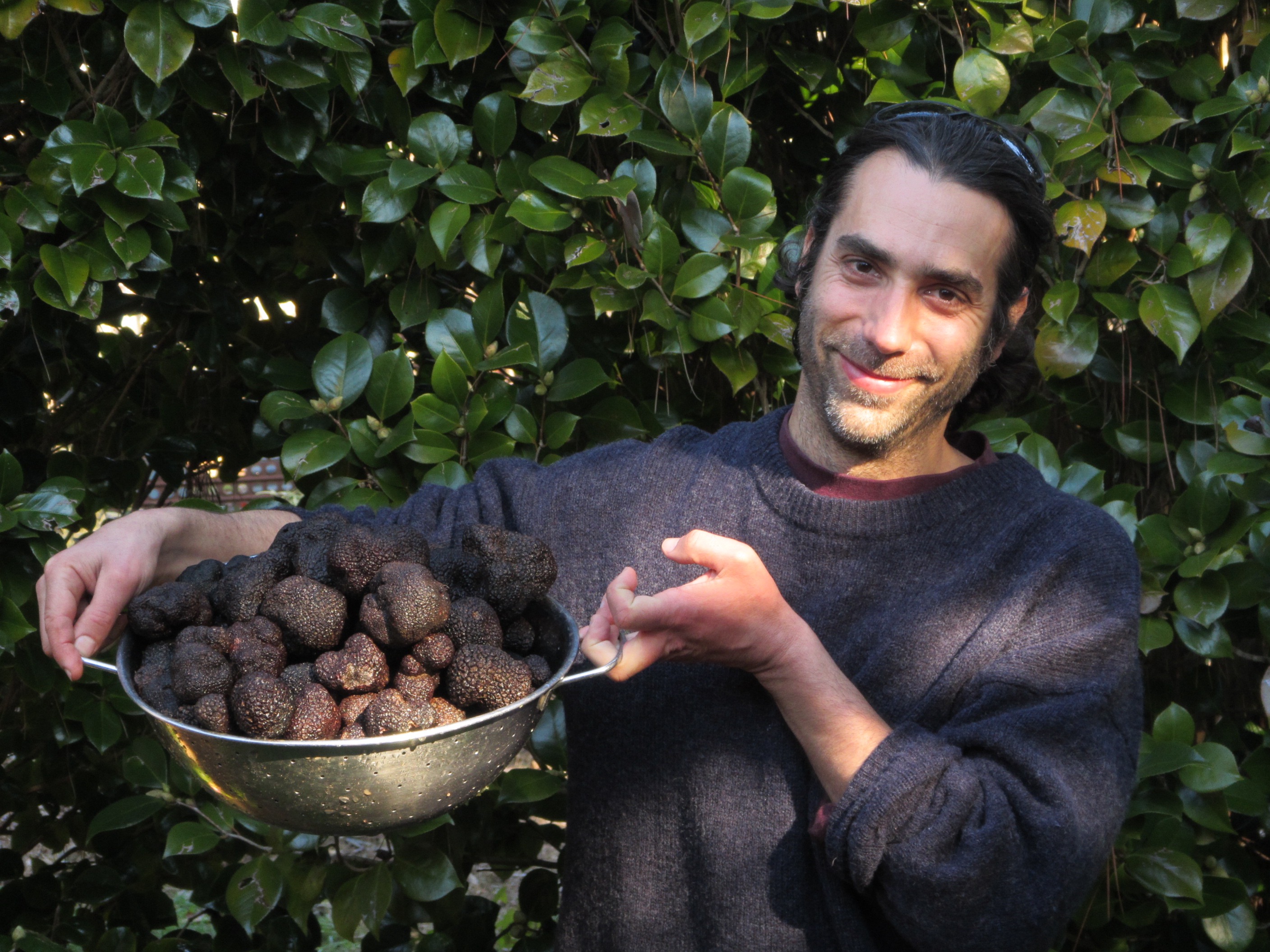
Black truffles have been cultivated for centuries in Europe, where the species is native. They were first introduced to Australia in the early 1990s, when growers inoculated oaks and other northern hemisphere trees with European truffle spores and sold and planted them around Tasmania, Victoria, New South Wales and Western Australia.
Since then, the country’s truffle industry has expanded to more than 450 farms producing truffle exports worth some $30-40 million each year.
And while truffle orchards in Europe turn out around 44 pounds of truffles per acre, some truffle orchards in Australia have reported yields up to 20 times greater than that.
“Some orchards have these grapefruit-sized truffles,” said EEB core faculty member Gregory Bonito, who has been studying truffles for nearly 25 years.
Truffles are mycorrhizal fungi, a type that grows among the roots of certain trees.
The fungi and tree roots form a symbiotic partnership. Threads of fungus envelop and intertwine with roots, helping them extract nutrients like nitrogen and phosphorous in exchange for some of the sugars the trees produce through photosynthesis.

Truffles are the fruiting body that forms when the fungi reproduce. But they aren’t the only fungi that live symbiotically with plant roots. Truffles share their underground home with numerous other species of mycorrhizal fungi too.
For the study, a team led by Bonito and Gian Benucci of MSU’s Department of Plant, Soil and Microbial Sciences analyzed microbial diversity in soils from more than 24 truffle orchards across France, Spain, Italy, and Australia.
At each site they collected spoonfuls of soil under and around truffle-infected trees, and bagged it for future genetic analysis, collecting some 522 samples over two years.
DNA sequencing revealed 4,415 genetically distinct fungi hidden in Australian soils, versus 6,575 in soils from Europe. For mycorrhizal fungi in particular, Australia’s soils were populated by 75% fewer species.
What’s more, T. melanosporum was more abundant in Australia’s soils compared with Europe’s. In the underground community of symbiotic fungi, it had more of a monopoly.
The results suggest that one reason black truffles have been able to thrive since they were introduced to Australia is they left their natural enemies and competitors behind, while those in its introduced range are less effective at outcompeting truffle fungi or slowing their growth, said Bonito, who is an associate professor in the Departments of Microbiology, Genetics, & Immunology; and Plant, Soil and Microbial Sciences.
Black truffles could owe their success in Australia to other factors as well. “Some people say it could be due to climate factors,” Bonito said. “Other people say it's because of their water, or how they prune, or some secret formula of their management regime.”
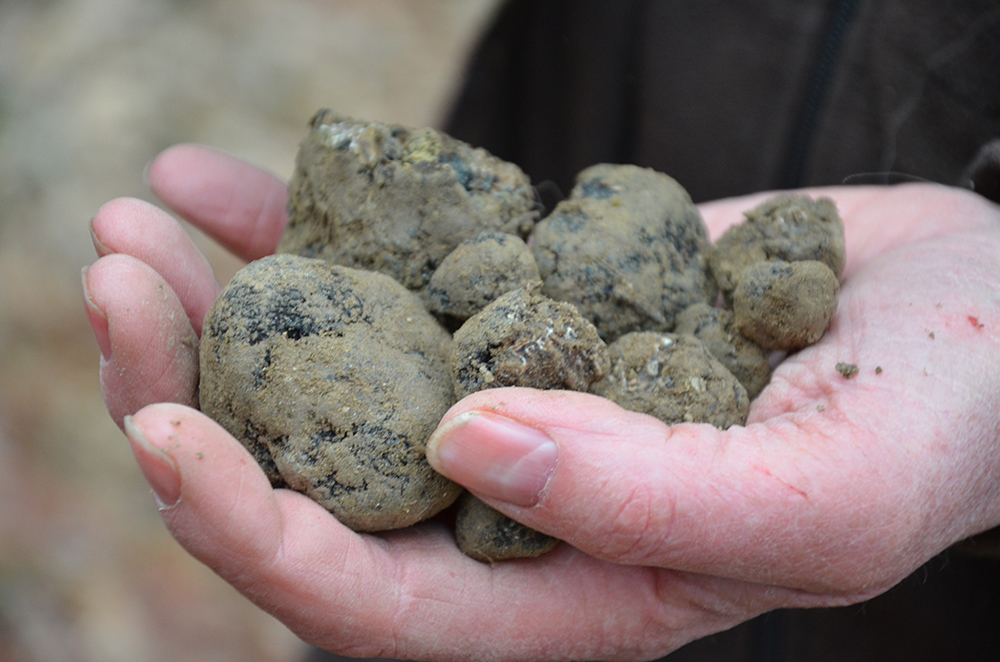
These coveted fragrant fungi (Tuber melanosporum) are so prized by chefs that black truffles are nicknamed the “black diamonds” of the kitchen, with prices that can exceed $1000 a pound. Credit: Wikimedia Commons.
“This research suggests there may be some bigger ecological factors working in their favor as well,” Bonito added.
“This dataset allowed us to use robust models that respect the data’s true story,” said Benucci, who performed the data analyses. "It wasn’t about forcing a result; it was about using the right tools to let the ecology speak for itself, even when the answers are complex."
Future research will focus on analyzing microbial diversity in truffle orchards in North America and other Southern Hemisphere countries, to see if the patterns hold up.
“The first country where black truffles were successfully cultivated outside Europe, in the 1980s, was the U.S.,” Bonito said. “Today there are hundreds of U.S. truffle farmers, however, truffle yields are not as high as Australia.” Bonito said. These findings could help explain why, he added.
The results were published April 3 in the journal Applied and Environmental Microbiology.
This research was supported by grants from the U.S. National Science Foundation (DEB-1946445 and DEB 1737898), the U.S. Department of Energy (LANLF59T), the French National Research Agency (ANR-11-LABX-0002-01), and Michigan State University AgBioResearch (NIFA project MICL02416).
CITATION: "Mycorrhizal competition release and microbial dynamics in native and non-native Tuber melanosporum habitats," Gian Maria Niccolò Benucci, Sergi Garcia-Barreda, Sergio Sanchez, Pedro Marco, Ana Maria De Miguel, Francois Le Tacon, Giorgio Marozzi, Leonardo Baciarelli Failini, Harry Eslick, Todd F. Elliott, Aurelie Deveau, Claude Murat, Domizia Donnini, Gregory Bonito. Applied and Environmental Microbiology, April 3, 2026. DOI: 10.1128/aem.00225-26
Featured in Smithsonian Magazine, Yahoo! News, Aol.com and The Guardian.