Spartans win prestigious NSF Graduate Research Fellowships
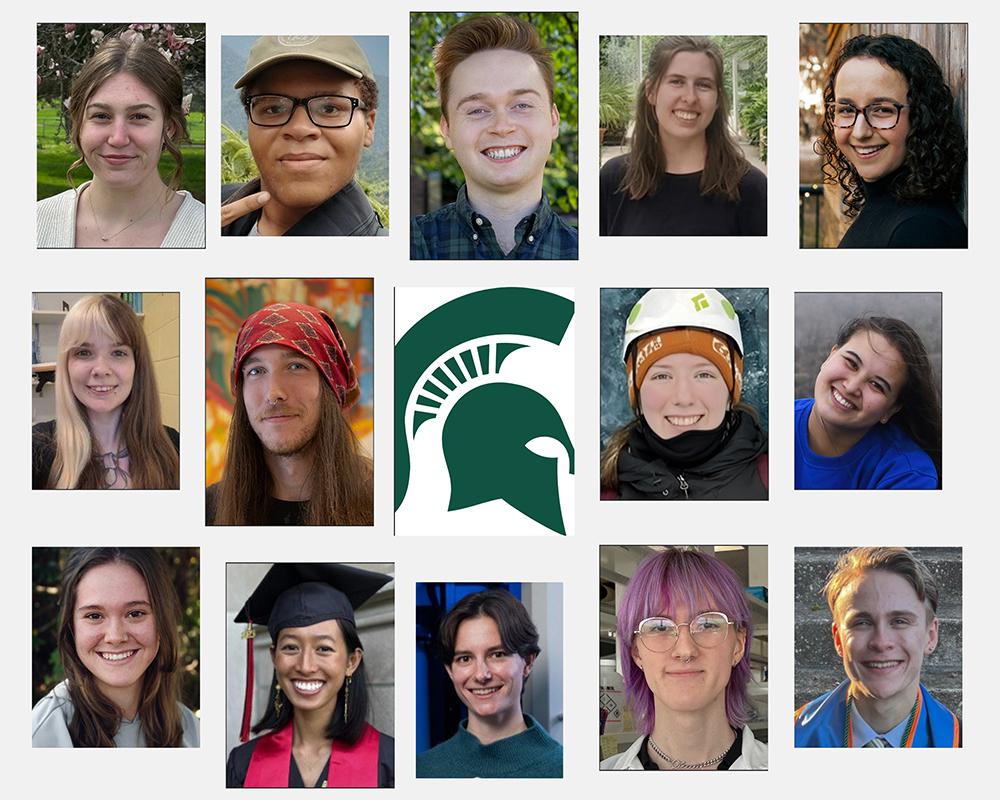
Eight current and incoming MSU life sciences students have been awarded prestigious graduate fellowships from the National Science Foundation, with an additional six given honorable mentions.
EEB student Kristin Leutgeb was sitting on the couch with a friend when she got the news, in mid-April, that she had been offered a PhD fellowship from the National Science Foundation’s Graduate Research Fellowship Program.
“I was shocked,” said Leutgeb, a first-year PhD student in entomology in the Glassmire lab. “I [had to] read the email a couple of times. I couldn't believe it said ‘congratulations.’”
“This is my second time applying,” added Leutgeb, who studies how chemical defenses produced by tomato plants influence insect pests and the parasitoids that keep them in check.
Minutes after learning that she had received a similar offer, incoming PhD student Alice Walker of the Heath-Heckman lab (also in EEB) found herself dancing around her living room, “to get the shock out of my system.”
“There was certainly a huge sigh of relief,” Walker said.
Leutgeb and Walker are among some of the eight current and incoming life sciences students at MSU who have been awarded the highly competitive graduate fellowships, with an additional seven given honorable mentions.
A large number of this year's awardees come from labs in MSU's Ecology, Evolution, and Behavior (EEB) Program.
MSU’s recipients are among some 2,500 students nationwide to receive the PhD fellowships this year, chosen from a pool of nearly 14,000 applicants. The awards come with three years of financial support over a 5-year period, including $16,000 towards tuition and a $37,000 living stipend.
The announcement is welcome news during a turbulent time for the program and for early-career scientists.
Citing budget cuts, last year the NSF announced a record-low number of GRFP fellowships. Only 1,000 students were offered awards in April — half the typical cohort. An additional 504 awards were added in July, still a significant decrease from the roughly 2,000 fellowships the foundation usually funds.
This year, many applicants had to scramble to prepare their proposals after the call for applications went out two months late. And changes in eligibility criteria meant, for the first time in decades, that second-year graduate students could no longer apply.
Launched in 1952 shortly after the NSF was established, the Graduate Research Fellowship Program is the nation’s longest-running investment in developing the talent pipeline for the U.S. STEM workforce. Since its inception, the program has supported over 70,000 fellows, many of whom have gone on to become leaders in research and innovation, including more than 40 Nobel laureates.
This year's investment at MSU also supports young scientists whose parents lacked the opportunity to pursue higher education, or who built their careers via other routes.
“I'm a first-generation college graduate, so also a first-gen PhD student,” said Walker, who plans to study how beneficial bacteria affect nervous system development in Hawaiian bobtail squid.
Walker is far from alone. Take Jenna Baljunas of the Zarnetske lab. The first in her family to pursue a Ph.D., she’s now using AI to study species interactions across an elevational gradient in Costa Rica. Or take Elena Renshaw, a first-year PhD student in Nina Wale’s lab. She plans to use the fellowship to study the evolution of pathogen resistance in Daphnia water fleas infected with the bacterium Pasteuria ramose.
“We are so proud of these students,” said EEB Director Elise Zipkin. “They have proven that they can articulate their science sufficiently enough to get funding, which is no small feat. We can’t wait to see what they discover and we look forward to supporting their success as they kick off their careers at MSU.”
The full list of students who received fellowship offers and honorable mentions can be found on the NSF website.
Awards in EEB labs
Jenna Baljunas (Zarnetske lab, integrative biology)
Kristin Leutgeb (Glassmire lab, entomology, plant biology)
Haley Martens (Fitzpatrick lab, integrative biology, Kellogg Biological Station)
Victor Remley (Eisthen lab, integrative biology)
Elena Renshaw (Wale lab, integrative biology; microbiology, genetics & immunology)
Sabriya Seid (Janzen lab, fisheries and wildlife, integrative biology, Kellogg Biological Station)
Alice Walker (Heath-Heckman lab, integrative biology; microbiology, genetics & immunology)
Bryce Waller (Bonito lab, microbiology, genetics & immunology; plant, soil and microbial sciences)
Honorable mentions
Edward Andrews (Heath-Heckman lab, integrative biology; microbiology, genetics & immunology)
Kendall Ash (Cheruvelil and Hanly labs, fisheries and wildlife)
Callie Rose Chenevert (Beaudrot lab, integrative biology)
Mataeus Funderburk (Gilbert lab, plant biology, Kellogg Biological Station)
Amelia McGinnis (Burrack and Sullivan labs, entomology, plant biology, Kellogg Biological Station)
Isabella Vergara (Sprunger lab, plant, soil and microbial sciences, Kellogg Biological Station)